
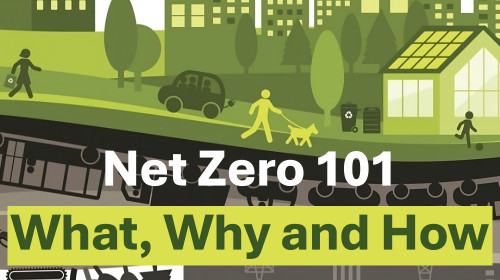
Understanding net zero requires understanding many climate science terminologies, and Net Zero 101: What, Why and How breaks down the science in easy-to-understand terms. Throughout the course, you will be provided with practical tips to contribute to climate action. By the end, you will gain a solid foundation in the science behind climate change and net zero. You do not need technical background in climate science to complete the course.
The course consists of three easy-to-follow short modules:
Module 1: What is Net Zero?
Module 2: Why Net Zero?
Module 3: How to Net Zero?
Each module takes about 20-30 minutes, depending on how you explore the modules. This is a self-paced course, allowing you to manage your learning time as you wish. Progress is saved automatically, granting the flexibility to complete all three modules in the schedule that best suits you.
At the end of each module, there will be a quiz. Upon successful completion of all the quizzes, you will receive a digital certificate issued by UNU-IAS.
For more information, visit the course overview page at UNU-IAS website here.
Target Audience
This e-course caters to anyone who wishes to develop a foundational level of understanding on the basic sciences behind climate change, its environmental, social and economic impacts, and actions we can take as responsible citizens to achieve a net-zero society, such as:
- Individuals who want to reduce their carbon footprint and contribute to a net-zero society
- Teachers interested in enhancing their curriculum with the latest climate science and empower their students
- Students who are climate advocates and want to make informed decisions about their future
- Policymakers interested in gaining knowledge to inform policy decisions on sustainable practices and net-zero transition
A computer or a smartphone with internet access is required to access the course. Please note that this course is conducted in English and does not include audio content.
Learning Objectives
After completing the course, you will be able to:
- Define what anthropogenic climate change is and link it with the concept of net zero.
- Identify UN organizations, key milestones and international treaties relevant to climate action.
- Analyze the environmental and socio-economic impacts of climate change, and explain the importance of a whole-of-society approach and the roles of different actors in achieving net zero.
- Describe the importance of contextualized measures to achieve net zero and determine sustainable and practical ways to reduce one’s carbon footprint.
- Select the most effective and viable renewable energy solutions considering their cost-effectiveness and sustainability given different contexts.
Offered by

Related
Climate Action: Solutions for a Changing Planet
Course
Self-paced e-learning
Offered by:
SDG Academy


Next Generation Foresight Practitioners - Young Voices Award 2022
Resource
Platform
Offered by:
Amna Habiba, Lisa Guilani
TTF