As 2030 approaches, the Sustainable Development Goals stand at a crossroads. While some targets are within reach, others lag dangerously behind. At the same time, the global order is shifting: geopolitical rivalries are reshaping alliances, conflicts are straining the international system, and the United Nations itself is grappling with calls for reform.
What happens to sustainable development in a world where trust in multilateralism is fraying, yet the need for collective action has never been greater?
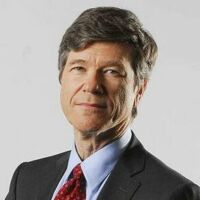
In this episode, we speak with Professor Jeffrey Sachs — President of the UN Sustainable Development Solutions Network, University Professor and Director of the Center for Sustainable Development at Columbia University.
[What follows is a transcription of the podcast, modified for enhanced web readability.]
Paulyn Duman: Welcome to the SDG Learncast with me, Paulyn Duman. In every episode, I bring you insightful conversations around the subject of sustainable development and learning, helping us all to achieve a sustainable future.
As 2030 approaches, the Sustainable Development Goals stand at a crossroads. While some targets are within reach, others lag dangerously behind.
At the same time, the global order is shifting. What happens to sustainable development in a world where trust in multilateralism is fraying, yet the need for collective action has never been greater?
In this episode, we are so happy to welcome and speak with Professor Jeffrey Sachs, the President of the UN Sustainable Development Solutions Network, and also University Professor and Director of the Center for Sustainable Development at Columbia University.
Welcome back to the SDG Learncast, Professor Sachs.
Jeffrey Sachs: Great to be back with you. Thank you so much.
Paulyn Duman: Can you tell us about your work at SDSN and Columbia University?
Jeffrey Sachs: I am a university professor at Columbia University. My field is sustainable development. I was trained as an economist, but I have been trying for the last 25 years to help create sustainable development, not only as a concept of the UN but also as a field of study.
Sustainable development means the “system of systems” approach, so that one looks at the Earth’s physical system, such as the climate system, the political, economic, and social systems, and aims to understand their interconnections so that we can actually use our public policies to move the world to the future we want, which is a future of sustainable development.
Paulyn Duman: You are working on “systems of systems” in the context of sustainable development. And when we look at the latest Sustainable Development Report 2025 and the SDGs today, which gaps worry you the most? And what lessons from your research, and from what you have also learned as an advisor, should inform a post-2030 framework?
Jeffrey Sachs: First, there’s good news, which is almost all governments in the world embrace sustainable development as a meaningful framework—and an important and useful one.
Sustainable development means the simultaneous achievement of economic, social, environmental, and geopolitical aims. In other words, sustainable development in a policy sense is goal-based development of a holistic approach: economic, social, environmental, and diplomatic or geopolitical.
Most governments around the world adopt this. My own, the United States, rejects it, but the US will return to the fold because its current self-isolation is very self-defeating. It does not reflect the views of the American people.
So the good news is that the agenda is really there. The bad news is that it’s not being achieved—and it’s not being achieved for many reasons.
Second, in general, is the financing of the SDGs. We just had the Finance for Development Conference in Seville, Spain at the end of June and beginning of July. Many practical ideas came out of that, but the bottom line was: the financing is not flowing to the low-income and lower middle-income countries, and it needs to flow.
The third point is that the SDGs are achievable, even though they’re not being achieved. When you analyze the gaps—whether financial, administrative, or management—the answer is that these gaps are not insurmountable. They require collective action. They require global cooperation. They require money, but the world economy is huge and the rich are very rich, and the rich countries are very rich.
So there’s nothing that stops us from achieving sustainable development, and the technological breakthroughs in AI, digital, renewable energy, and other areas give us better and better tools for achieving sustainable development.
Paulyn Duman: Let’s imagine that you can redesign post-2030. If it were up to you, how would you redesign the next global agenda on sustainable development, and the political context by which the new global agenda will have to thrive?
Jeffrey Sachs: I would generally keep the goals so that we’re not pulling the rug out from governments. We’re not forcing them through new hoops. It took a long time to learn these goals, and I would like the framework to continue. But I would like the focus to be on the means of implementation.
And that means financing, organization, technology, and global cooperation. The UN is not generally in its strongest suit on finance because the UN doesn’t have finance of its own. The UN looks longingly at those private capital markets and says, “If only that money would flow to the areas we want.” And sometimes in the past when it has intervened, it’s been told, “That’s not your department. This cannot be.
We need a serious financing approach—not only to say there are gaps (it’s obvious that there are financing gaps)—but the next round should be on the practical solutions. Whether it is the big scaling up of our multilateral and official development banks, which is one way to do things; whether it is reforming the credit rating system entirely so that it’s compatible with long-term growth and sustainable development.
So I would put a big focus on means of implementation rather than goal setting. Solution achievement should be the main theme.
Paulyn Duman: I want to focus on global cooperation, means of implementation, and of course technology, finance, and different means. How can it work in an era of regional power shifts?
Jeffrey Sachs: First, many countries are very keen on cooperation, and China I would put at the top of the list. China has the Belt and Road Initiative. It’s a very important initiative. It’s provided large-scale finance to dozens of countries around the world.
Typically, the US denounces the Belt and Road Initiative, which is a sign of jealousy more than anything else.
China’s actually doing something, and the United States isn’t doing anything, and so it complains that China’s actually doing something. We should applaud those who are actually doing.
And I would emphasize China as one. I would emphasize the Gulf countries that are putting their money behind sustainable development.
So there are many signs of global cooperation. But because the country that typically was at the center of things—the United States—is not part of it right now, it looks like global cooperation doesn’t exist. I think we need to rethink this situation, because there’s actually a lot of global cooperation.
We need groups of countries to be acting in a forward and proactive way.
Paulyn Duman: Should we make the next set of global goals include enforcement mechanisms, or do you think that would risk politicizing the processes that we have?
Jeffrey Sachs: One way you could say enforce outcomes—but I wouldn’t quite call it enforcement—is to create systems at the global level that provide revenues needed for success.
When we say enforcement, right now, for example, on development aid we have a goal: every country should contribute 0.7 percent of its gross national income. And there’s no enforcement of that.
But another way to approach that financing would be global taxes that are routinely collected and go towards development finance, so that it doesn’t depend on enforcing the actions by one government at a time.
So I believe global taxation is an example of a way to strengthen the international system and the UN that will get us beyond begging each government to pay its dues. Now, what kinds of global taxation? We have several that could be implemented. Ideally, it would be on areas that are not taxed at the national level, for example.
So, international aviation is one obvious one often mentioned. International sea shipping is a second one that is often mentioned. International financial transactions—a small financial transactions tax, which has been discussed for decades—could raise a huge amount of revenue.
So global taxation is one very important dimension that is missing from the global architecture right now. Now, the US hates this idea. If there’s one idea the US hates perhaps more than any other, it is to be taxed. And Donald Trump threatens other countries: “If you dare to tax our companies, we’ll put crushing sanctions on you,” and so forth. “We’ll put crushing tariffs on you.” This is completely irresponsible and abusive.
But the way forward, frankly, is for 150 countries to say yes, we go ahead. And even if the United States doesn’t go ahead, we get most of what we want right now. I want to keep a running tab—maybe it should be in Times Square in New York—of all that the US owes the rest of the world that it’s not paying right now.
Paulyn Duman: Let us talk about BRICS and other emerging groupings and economies. How do they compare with regional blocs like the African Union, ASEAN, or the EU in shaping the multilateral system?
Jeffrey Sachs: Let me distinguish between the BRICS and, say, ASEAN or the African Union. The BRICS is a group of important emerging economies. It started with five: Brazil, Russia, India, China, and South Africa. It now includes Egypt, Ethiopia, the United Arab Emirates, Iran, and Indonesia.
It’s now ten plus a number of additional partner countries that want in. What is useful about the BRICS is that these are emerging economies that are basically saying: we want a multilateral system, not a US-dominated system. So it is a system that is created really in counterpoint to the American bullying, if I could put it that way. Because the United States is the country that uses the most sanctions, that weaponizes the US dollar, that has military bases all over the world.
The BRICS, in my view, is a very positive grouping. The BRICS are saying: we want multilateralism, we want the UN system to work. We don’t want to be bullied around by anybody else, but we want the UN system to work. The BRICS have created the New Development Bank based in Shanghai, and I think that this is also an example of an institution that can be scaled up considerably to provide a lot more financing.
All of this means we should build the global cooperation in a way that doesn’t deplete all of our energy on the obstacles, but moves forward as fast as we can when we find those countries that want to move forward together.
I would distinguish that from the regional groupings like ASEAN, or the African Union, or the Central Asian Five, or the Gulf Cooperation Council, the Arab League, and others.
The regional groupings are very important because—two reasons. One, it gives voice to these regions in global diplomacy. But even more than that, so many of the solutions that we have are supranational. They are beyond an individual country.
Take renewable energy, for example. If ASEAN wants a zero-carbon energy system based on hydropower, solar power, wind power, ocean power, it needs to connect a grid that connects Vietnam, Cambodia, Laos, Thailand, Malaysia, Indonesia, and so forth—the ten ASEAN countries. Because no country has the resource base within itself to provide an efficient, resilient, robust, low-cost, zero-carbon energy system.
Whereas if the region works as a whole, it can do so. And similarly, the region is a site of shared ecology. So Southeast Asia has a rainforest ecology that’s under threat. Or consider the nine countries of the Amazon basin. The Amazon we think of as Brazil. But of course, it’s not just Brazil—it’s all of the countries around Brazil in a shared ecosystem.
So the region becomes very important for solutions. It becomes very important for integrated infrastructure: power, water, transport, digital access. And that level of government is difficult, because individual nations have to give sovereignty and resources to a higher level of governance. And we see even Europe, which has been at this the longest, is having a quite hard time of this. It’s not easy to coordinate. But I note in every region of the world where I’m traveling nonstop, these regional groupings are becoming more important.
Paulyn Duman: There are different levels of governance, and of course there are also different sectors and stakeholders. How do we bring out the best, and perhaps increase the engagement of the private sector, civil society, and the youth in the design of the next agenda—not just in the implementation?
Jeffrey Sachs: We have several levels of government. We have government at the global level through the UN Charter. We have regional governance such as the African Union or ASEAN.
We have national-level government in almost every country of some size. We have provincial or state-level government. And then we have local government—cities and towns.
You can’t do—and certainly can’t do successfully—without all of those levels working. It’s not a choice of UN versus regional versus national. They each have their job to do. And the basic way to think about it is: take a problem, say the school system. That actually can be addressed pretty much at the local level.
Take a highway system—pretty much that can be addressed at the national level. Take a rail—that is transnational, almost surely. Take renewable energy—that is almost surely regional. Take climate change regulation—that has to be global, because of the way that the atmosphere works. If we each made our own climate, this problem would be very different. But we make each other’s climate, and therefore there needs to be a common approach to that.
So I don’t see any way around five active levels of government—global, regional, national, provincial, and local—and all of them have to be working very efficiently.
Every sector has its distinctive characteristics, because each sector is a mix of what we call public goods—needed to be provided by the public sector—and private goods that can be provided by the business sector operating on a for-profit basis.
So if you’re looking at scientific research, then the weight is kind of 50/50. Or maybe the government is a quarter, the university sector is another half, and the private sector is a quarter. I’m making it up, but just for illustration.
If it’s education, the government is the predominant actor. If it’s tourism, the private sector is the predominant actor. So each sector requires its own mix of public, private, and civil society entities and its own strategy. Industrial strategy is a reality, because whether it’s the power sector, the manufacturing sector, the chemical sector, or the transport sector, it needs to be planned to some extent. It’s not just the magic of the marketplace. There needs to be an infrastructure strategy, a training strategy, and so forth.
But each sector has its own characteristics, and so we shouldn’t expect one approach is going to work for healthcare, education, tourism, manufacturing, or the energy sector. Each one will have to be tailored. That’s the art of governance.
Paulyn Duman: Now, with the acceleration of technology—AI, biotechnology, climate tipping points, but also climate technology—how do you see technology future-proofing the next sustainable development agenda?
Jeffrey Sachs: There are two issues of technology. One is using the tools, which are advancing at a remarkable speed. I recently toured a solar panel factory in China. The price of a watt of solar module now is 8 cents US a watt. I remember still when it was a hundred dollars a watt, and then miraculously it came to 10, and then a dollar, and now it’s a tiny fraction of a dollar.
This is a process improvement of an astounding rate. We know this throughout the digital world in countless areas. That’s our empowerment. Our tools are better than ever. That’s one side of technology.
The other side of technology is the downside—that technologies need governance because they can be abused. Digital can lead to cyber warfare. It can lead to fake news. It can lead to addictions. It can lead to many harms. Technology can be weaponized. A lot of dangerous research is underway that is not governed.We know AI poses new risks.
So the second part of technology is governance—to make sure that these technologies do not lead to recklessness, do not lead to misuse, do not lead to concentrations of power of unimaginable consequence.
We’re having various discussions worldwide about AI or about advanced biotechnologies and so forth. We have not had real governance answers yet, partly because powerful companies—the big tech industry, for example—say, “No, that’s ours. That’s not yours. We’re not going to be governed.” Or the US says, “No, this is for our military. That’s our business, not your business.” We actually need global governance of these institutions.
Paulyn Duman: Is it time to move beyond the 15-year global goal model—towards something more adaptive and iterative?
Jeffrey Sachs: Yeah. Just as a practical matter, I would suggest that we move to mid-century for our new goal. There’s a certain logic and roundness to moving to 2050. And it’s about the right horizon for planning.
It’s long-term, but it’s not so long-term that it’s going to be overwhelmed by unknowns. It’s short enough that we can actually think rather concretely about what to do, but long enough that it forces us to think about the slow-moving changes of our physical infrastructure, our city structures, demographics, and so forth.
So I would urge that the next cycle be to mid-century, and think that with that perspective we can gain a lot. It’s just a little bit longer than the earlier 15 years. These 15-year cycles are really helpful. I’ve been involved with both the Millennium Development Goals and the Sustainable Development Goals.
I would say the MDG agenda was more focused, especially on the poor countries. It produced a lot of practical advances. The SDG agenda has been much more complicated. And in a way, it has produced fewer specific advances because of the overwhelming reality of all of these short-term global crises that we’ve been talking about.
But this kind of goal setting helps. It forces thinking. It forces looking ahead. It forces planning. It forces joint actions. And so we should understand that it’s the right approach for what we need to do.
Paulyn Duman: And do you see hope?
Jeffrey Sachs: Of course, I see hope. I see a world in transformation—from a basically Western-dominated world, where the West means the North Atlantic of Europe and the United States—to a truly multipolar world.
It means that there’s more shared capacity, technology, expertise, incomes, wealth, and financing than ever before. The rise of China, the rise of India, the growing strength of the African Union, and other regional groupings—all of this gives me hope that capacity is growing around the world.
I want our major regions to think: you must work together. Stop emphasizing all the conflicts and emphasize the regions the reasons for cooperation, coordination, and peace. And then take note: with these amazing technologies and tools, we can really do what we need to do.
Paulyn Duman: That is very hopeful and insightful. Thank you so much, Professor Sachs, for your time, and we wish you all the best.
Jeffrey Sachs: See you again soon. Thank you so much.
--
Paulyn Duman is the Knowledge Management, Communications, and Reporting Officer at the United Nations System Staff College (UNSSC) Knowledge Centre for Sustainable Development and is a coordinator for the Joint Secretariat of UN SDG:Learn, together with UNITAR.
The opinions expressed in the SDG Learncast podcasts are solely those of the authors. They do not reflect the opinions or views of UN SDG:Learn, its Joint Secretariat, and partners.
Related
Beyond Action: The Role of Inner Development Goals for a Sustainable Future
Microlearning
 Podcast
Offered by:
Åsa Jarkskog (Director Global Collaboration, Inner Development Goals)
Global finance in transition: Reforming the global financial system for the SDGs
Microlearning
Podcast
Offered by:
Guillaume Lafortune (Vice President of the Sustainable Development Solutions Network (SDSN))
Great Buys in Education: Maximizing learning in low and middle-income countries
Microlearning
Podcast
Offered by:
Benjamin Piper, Director of Global Education (Bill & Melinda Gates Foundation)
Tomorrow's Classroom: Digital Transformation through Systems Thinking
Microlearning
Podcast
Offered by:
Breanne Pitt, Research Fellow (World Economic Forum)

Transforming Economies for Sustainable Development
Course
Facilitated e-learning
5 Aug 2023
Offered by:
UNSSC