The IDGs offer a framework for cultivating the human capabilities, qualities, and skills essential for building a sustainable, equitable, and thriving future for all.
In this episode, we will explore how the IDGs complement the SDGs by focusing on the inner dimensions of change, such as self-awareness, emotional intelligence, mindfulness, and resilience. These inner qualities are critical for addressing the complex challenges of our time and for driving meaningful, systemic change towards sustainability. Our discussion with Åsa Jarskog, the Director Global Collaboration of the Inner Development Goals will cover the origins, development, and applications of the IDG framework, showcasing how it equips individuals, communities, and organizations with the inner skills needed to effectively contribute to the global sustainable development agenda. Let us unlock the synergy between inner transformation and outer action, illuminating a holistic path to achieving a sustainable future for all.
[What follows is a transcription of the podcast, modified for enhanced web readability.]
Paulyn Duman: Welcome to the SDG Learncast with me, Paulyn Duman. In every episode, I bring insightful conversations around the subject of sustainable development and learning, helping us all to achieve a sustainable future.
In this podcast episode, we will look into the transformative power of the Inner Development Goals, or IDGs, and how they support achieving the 2030 Agenda for Sustainable Development and the Sustainable Development Goals, or the SDGs.
In this episode, we will explore how the IDGs complement the SDGs by focusing on the inner dimensions of change, such as self-awareness, emotional intelligence, mindfulness, and resilience. As our guest, we have Ms. Åsa Jarkskog, who is the director for global collaboration of the Inner Development Goals. Welcome to the SDG Learncast, Åsa.
Åsa Jarkskog: Thank you, Paulyn. It's wonderful to be here with you today.
Paulyn Duman: Åsa, tell us about yourself and how you came to work with the IDGs.
Åsa Jarkskog: I've been working with sustainable development in one way or another since 1990, when I started a career with the UN. When the SDGs were launched, I was very thrilled that finally, we had an agenda that was approved by all countries, and we had common goals and clear indicators on how to reach a more sustainable world, and it felt quite comprehensive. But with time, I think I share this frustration with many people.
I realized that we are not reaching those targets, even though we do have the resources on a global basis, and we do have the technology. Somewhere, we must be doing something wrong. That's when I came across the IDGs and felt that they were the missing link.
Paulyn Duman: And what is your role within the Inner Development Goals?
Åsa Jarkskog: When I joined the IDGs, they were quite big in Sweden. It's a fairly young organization. It was launched three years ago; we just celebrated our third-year anniversary. But having worked myself in 61 different countries, I was approached by the IDGs and asked to bring the framework out to the world and, in particular, to the Global South.
My response was, "No, I'm not going to bring something to the Global South, but I can go into a dialogue with people from other backgrounds and see what their take on this framework is. I believe we may need to redefine the framework when we go into that conversation."
That's what's happening now. We are doing a global survey where we are redefining the particular skills that the framework currently presents. I'm from Sweden, and when somebody talks about the SDGs and sustainability in Sweden, they're very much focused on the climate crisis, which is the biggest challenge we have here in Sweden. But in many of the countries I have lived and worked in, poverty, hunger, access to education, access to health—those are the big challenges that people are dealing with.
So what I have done is have this dialogue with many different countries and also co-create a capacity development program where we link the IDGs to the SDGs and see how by integrating inner development, not only on an individual level but also on the organizational level and on a systemic level, (we can see) how that can actually contribute to a more sustainable society.
Paulyn Duman: What inspired the inception of this IDG framework?
Åsa Jarkskog: The people that initiated the research were sharing this frustration about the world not becoming more sustainable, or not at the pace we need, and started to look at what the human capacities are that are necessary to develop in order to reach a more sustainable world. Because if it's not about money or resources, it has to have something to do with the ones that actually created these problems in the first place, which is us, human beings.
There's a lot of research out there that is pointing in that direction, that if we can develop skills like empathy and compassion, for instance, we would become better equipped at working with sustainability. A number of academic institutions, especially in the Western world but also (in) other parts of the world, did a global survey and started looking at what those human capacities would be.
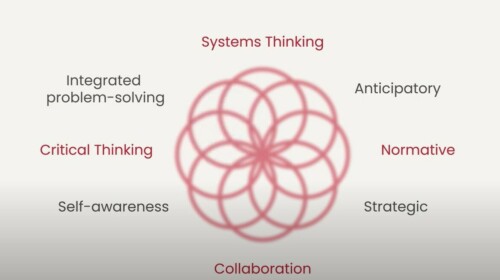
It was agreed that let's divide these different capacities, human capacities, into five dimensions, and those dimensions are being (how we relate to ourselves), thinking (that's our cognitive skills), relating (how we relate with other people and the world), collaborating, and the last dimension is acting. Extremely important because all the other ones are important, but if you cannot act upon them, change will not happen.
Paulyn Duman: What is important for me is that we all want to have this journey towards a more sustainable future. What do you think are the key inner skills and qualities that the IDGs framework highlights as essential? And how do these foster effective leadership, decision-making, and community engagement?
Åsa Jarkskog: Actually, for me, it's very difficult to highlight one or two skills or capacities. It's more important to look at the framework as such and the dimensions, because each of us may have skills that we are confident talking about, for instance, self-awareness, to understand our own motivations and impulses. (Or) critical thinking—we are in a world of a lot of fake news, and to be able to determine what is trustworthy is much more important than ever.
I feel that currently, empathy and compassion are extremely important, and empathy and compassion are not very often valued when it comes to people in government ministries or military leaders, but they are extremely important in order to work for a more sustainable world. (Also) communication skills, perseverance in acting—and I think we must not lose hope, so perseverance is also extremely important.
On a global basis, there is one capacity that I have seen that we are lacking in so many parts of the world, and that is trust. But the good news is that we can improve on all these skills. We can continue to develop as human beings for the rest of our lives.
Paulyn Duman: At the global scale, what is missing is trust, but this is something that we can work on, what we can build on, we can improve.
How are the IDGs integrated at the organizational level or at the sectoral level? And what are some of the challenges and breakthroughs that you have surveyed in embedding these inner skills in various sectors committed to the Sustainable Development Goals?
Åsa Jarkskog: One of the challenges for the IDGs is to be able to communicate with all sectors of society, with all different stakeholders, not only with individuals in civil society but also with the corporate world, academia, (and) government.
We also collaborate with the UN, and usually, these groups do not always meet together, so we are trying to speak a language that everybody can relate to. To integrate inner development on an individual level is not easy to start with, but it is much easier than to do it on an organizational level. And eventually, to integrate it on a systemic level, you need to really build trust and collaborate with other stakeholder groups in your society.
In the educational system, it's been integrated, for instance, in India, in the National Education Policy 2020, that has a key role for developing inner skills. Of course, to have these policies actually implemented all over the schools is something that takes time, but we have seen—and I had the pleasure of hosting a track in our IDG Summit last year in Stockholm—where there were some kids on stage that described how they have strengthened themselves through IDG training and, for instance, how the level of bullying has been reduced extremely in their schools.
Naturally, we also need to work on the policy level. We cannot only work with the children. We are working with the OECD; we're collaborating with the OECD, and they have researchers working with the PISA framework in order to highlight which indicators in the PISA framework that can actually support (the) integration of IDGs into schools. There are already some of those indicators in the framework, so it's partly a question of highlighting them. The more we can get that into the educational system, the more that our future leaders will be equipped to operate in the complex world that they are going to lead.
The first government that was very keen on the IDGs was the government of Costa Rica. And they immediately said that they wanted to integrate this into their policies, into the guidelines for policy development of their country.
But I'm currently leading a global capacity development program where there are representatives from (the) governments of many other countries: India, Albania, Tunisia, the UK, the Netherlands. I worked with Rwanda and Zambia, and they also participate in these training programs to integrate inner development (into) the operations of their organizations, and eventually into their systems.
In the corporate (world), it's a bit easier because it was a long time ago when the corporate world understood that culture eats strategy. We have been working with big companies such as Ikea, Spotify, Houdini, Novartis, et cetera. So that is probably the easiest area for us when it comes to introducing Inner Development Goals.
Paulyn Duman: That is amazing. (It's) interesting, especially now with the emergence of generative AI in the last months. The paradox is really that the most valuable skills of all in the future will be those intrinsically, blatantly human. These are critical thinking, collaboration, communication, (and) creativity—so, out-and-out human collaboration.
(The) IDG framework emphasizes presence, mindfulness, and long-term orientation. People have to go out of their short-term thinking. But given the perceptions that the IDGs might be seen as esoteric or overly sentimental, how do you address these views and demonstrate the practical relevance and impact of IDGs on achieving sustainable development?
Åsa Jarkskog: Thank you, Paulyn. It's a good question, and that was actually my view of the IDGs as well before I unpacked them and somebody helped me to unpack it. As I mentioned to you, the IDGs consist of five dimensions: that's the being, thinking, relating, collaborating, and acting. Now, if you take capacities like mindfulness (and) presence, they are very much in the being dimension.
Long-term orientation is very much in the thinking (dimension). But we should not forget that we have also included skills like co-creation and mobilization—skills (that) are extremely important. They are in the collaborating dimension. And in the acting (dimension), we have courage, creativity, (and) optimism. So it's about developing in all the different areas. And one thing we do is, to (begin with), look at, am I too much in the acting (dimension)? Maybe I need to sometimes pause and be present and take perspectives. I'm one of those people. I really like to act.
Of course, people who are my opposite, those are the ones I really need to team up with because they are better at reflecting and looking at different perspectives, et cetera. So the framework is not there to promote one way of being but (to look at) how we can complement each other to actually make change happen in this world, to take the world—through the individuals and the organizations and the systems—through this painful but absolutely necessary transformation.
Paulyn Duman: You mentioned creativity, and this is a really crucial component in overcoming sustainable development challenges. Can you tell us how the IDGs encourage these qualities in individuals or organizations that are working towards achieving the SDGs, particularly if they're not creative?
Åsa Jarkskog: Oh, that's a very good question. I've done a lot of leadership training in many different countries, and I've often had the question posed to me, "How do I make my organization more innovative?" And I think my first answer has been, "What is the trust level in your organization? And how much psychological safety is there in your organization?" If people feel that they need to perform all the time and they're not allowed to make any mistakes, then of course they're not going to be innovative, because being innovative requires some mistakes along the way. But then as a leader, if you tell other people that they can make mistakes, but you are not willing to make any mistakes yourself because you want to be perfect, then, of course, they are not going to (be innovative). You need to walk the talk.
So it's very much about being on a journey together and co-creating, and embracing the mistakes that actually take us to innovation. I don't know how much you know about the U theory that has been developed at MIT, but we work very closely with MIT as one of our partners. And I did U Lab myself 10 years ago.
And it's very much about not downloading what you already know, but actually sensing the future as it comes to you. And then, we need to use different languages in different kinds of organizations. When we enter a government office, we don't start by meditating with them and (saying), "What is emerging to you?"
On the other hand, we have a beautiful network of hubs, which is not (a) particular format of organization. It's just people that, or organizations or whatever, that want to contribute to the development of the IDG work. And we have 550 hubs all over the world in 95 different countries. And what we try to do when we work with the hubs is really just to enable whatever wants to emerge, and a lot of innovation and creativity is taking place in the hubs and networks.
Paulyn Duman: What is an insight that you have observed so that people who feel like they're lacking creativity can overcome the fear of committing mistakes and being perfectionists?
Åsa Jarkskog: That's difficult to give a formula (for), but I've been running a lot of different capacity development programs throughout the years. And I think my main lesson is that less is more. We just recently had a gathering in Tunisia, and when we arrived there, my colleagues were asking me, "So where are the PowerPoints and where is the projector?"
And I said, "No, we didn't take people all the way to Tunisia to show them slides. We can do that online. We are here to get to know each other, to trust the process, and to co-create. To let go of control, for me, has been a way to help me bring out the best (in) the people I work with.
And to trust that people really want to contribute and not have an idea of exactly what the outcome must be, but rather welcoming what emerges and (to) build on that together rather than judging whether it is right or wrong. If the will is there, the result will be positive. So it's more about creating that atmosphere and trying to formulate a common vision than looking at exactly how things must be done.
Paulyn Duman: What would be something that you want to impart to our listeners who would like to integrate the Inner Development Goals in their daily life?
Åsa Jarkskog: That's a good one. Like I shared with you, Paulyn, I've been driven by a vision all my career, that we can reach a more sustainable world. But I was starting to lose hope until I came across the IDGs, because I knew there was something missing, but I just didn't know what it was. I was working in leadership development, so I knew it had something to do with people. It's about relationships. It's about what we do together, how we collaborate, how we co-create, how we make things happen.
And for me, having something so simple and so accessible that can be integrated in so many different kinds of organizations and circumstances, it gives me hope.
So why don't we just, you know, join hands and do this? And if we realize that we're having (difficulty) doing it, then we may need to work in our individual capacities. We need the trust and we need the courage, but we can do it.
It's not too late. It's about time. And I think the world is ready for it.
---
Interested in learning more? Check out how you can get involved with the IDGs:
- Learn more about the IDG Framework here: https://innerdevelopmentgoals.org/framework/
- Get involved with local Hubs here: https://innerdevelopmentgoals.org/get-involved/hubsnetworks/
- Take action with our toolkit here: https://idg.tools/
---
Paulyn Duman is the Knowledge Management, Communications, and Reporting Officer at the United Nations System Staff College (UNSSC) Knowledge Centre for Sustainable Development and is a coordinator for the Joint Secretariat of UN SDG:Learn, together with UNITAR.
The opinions expressed in the SDG Learncast podcasts are solely those of the authors. They do not reflect the opinions or views of UN SDG:Learn, its Joint Secretariat, and partners.
Related
Banking on Biodiversity: The Seed Savers’ Crusade
Microlearning
 Podcast
Offered by:
Dr. Stefan Schmitz (Executive Director of the Crop Trust),
Practical Guide to Data Storytelling in VNRs and SDG Reporting
Resource
Document
Offered by:
United Nations Statistics Division
UN DESA
Developing and implementing bilateral labour migration agreements
Course
Self-paced e-learning
Offered by:
ILO, IOM, ITCILO

Thai SDG Micro-Primer: learn and act for our common future
Course
Self-paced e-learning
Offered by:
UNSSC