
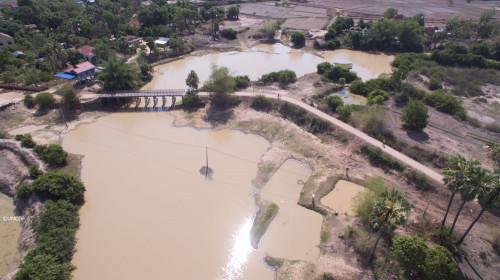
On behalf of the German Federal Ministry for Economic Cooperation and Development (BMZ), the Deutsche Gesellschaft für Internationale Zusammenarbeit (GIZ) GmbH is supporting the Pakistan government to improve the conditions for climate adaptation and resilience as well as climate risk management with a specific focus on vulnerable population, especially women.
The project “Strengthening Climate Adaptation and Resilience (SAR)” supports the entire planning cycle of climate change adaptation measures: from the preparation of climate risk assessments to the piloting of financing approaches and instruments. It contributes towards the National Adaptation Plan (NAP) as well as the Global Nationally Determined Contributions (NDC) Partnership, while also supporting the measures at the local level as well as upscaling through international climate finance.
In the context of the SAR project, UNITAR’s Green Development and Climate Change Unit comes to support the capacity-building component through the design, development, and implementation of this online, self-paced course on strengthening climate change adaptation and resilience. Nevertheless, the course does not provide exclusively Pakistani case studies, but also case studies from other Asian-Pacific countries and a solid core general content on climate change adaptation as one of the main pillars of the United Nations Framework Convention for Climate Change (UNFCCC).
The course 'Strengthening Climate Adaptation and Resilience' focuses on the importance of adaptation to climate change. The course provides a comprehensive learning pathway starting with climate change fundamentals, including climate risks and vulnerabilities assessment. Building on that, it continues with the integration of adaptation to climate change considerations into governmental planning and budgeting processes, and finally, it delves into the diverse financial mechanisms, tools, and strategies critical for effectively funding climate change adaptation initiatives.
This self-paced distance learning course is designed to meet the needs of busy full-time working professionals. The content is delivered in short digestible learning units allowing participants to engage at their convenience and control their learning pace, thereby supporting the adult learner's desire for autonomy in their learning journey. The delivery format is varied to stimulate engagement and includes interactive lessons, videos, reflective questions, formative quizzes and practical exercises. The learning objectives of each module will be assessed through short quizzes including various question formats such as multiple choice, multiple answers, matching, true and false, ranking, fill in the gap etc.
The e-course is structured in three modules, with each module including several lessons:
- Module 1: Climate Change Adaptation: the basics - Introduces fundamental concepts of climate change adaptation.
- Module 2: Mainstreaming Climate Change Adaptation into Planning, Budgeting and Decision Making - Looks into the integration of adaptation to climate change considerations into governmental planning and budgeting processes.
- Module 3: Financing for Climate Change Adaptation - Covers diverse financial mechanisms, tools and strategies critical for effectively funding climate change adaptation initiatives.
The successful completion of the course rewards the learner with a certificate. To complete the course, the learner must complete all three modules and pass each associated quiz with a minimum grade of 70% from no more than three attempts.
Download SyllabusTarget Audience
While the course features many Pakistani case studies, serving Pakistani civil servants, it also caters to:
- Civil servants in planning and development departments of various line ministries such as environment, agriculture, industry, finance, development, etc. at the local and national levels;
- Stakeholders from non-governmental organizations and community groups focused on climate change adaptation and resilience.
Learning Objectives
The core objectives of the e-course include enhancing knowledge of incorporating climate change into planning, budgeting, and decision-making in an inclusive manner, boosting individual capacities within governments for climate change adaptation through nationally appropriate strategies. Additionally, the course offers insights into innovative financial instruments for financing climate adaptation. It has been designed and developed through a gender lens, embracing an integrated approach whereby case studies feature how these issues have different impacts on different groups of people enforcing the importance of considering all community members when dealing with these issues.
Related

Advancing Sustainable Development in Practice
Course
Self-paced e-learning
Offered by:
UN CC:Learn, UNDP, UNEP
Synergizing Disaster Risk Reduction and Climate Change Adaptation
Course
Self-paced e-learning
Offered by:
UNSSC, UNDRR
The Fight for Our Forests and Future
Microlearning
 Podcast
Offered by:
Tyson Miller, Director (Earth Insight)

Transforming Economies for Sustainable Development
Course
Facilitated e-learning
5 Aug 2023
Offered by:
UNSSC